

-
What is the philosophy behind SANMEIHO knives?
SANMEIHO, meaning "Three-Layer Integration" in Japanese, represents our commitment to the alchemy of cutlery. Our brand balances the wisdom of traditional blacksmithing with the precision of modern industrial technology.
We believe that professional-grade sharpness and durability should be accessible to every home chef. By fusing soft steel for impact resistance, hard steel for edge retention, and a structural core for harmony, we create knives that perform at the highest levels without the restrictive price tag.
-
What is the "Three-Layer" manufacturing technique?
The Sanmeiho technique is the core of our brand’s performance. Every blade is constructed from three distinct layers of steel:
The Soft Foundation: Acts as a flexible network to absorb impact and prevent brittleness.
The Hard Edge: Our high-carbon or powder steel core provides the "technology edge," ensuring extreme precision and razor-sharp cutting.
The Balanced Core: A structural layer that binds these two opposites, ensuring stability.
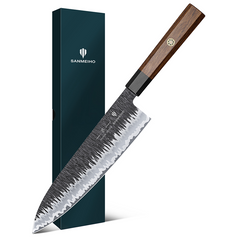
This allows our knives, such as those in our Scoria or Black Horn series, to be more resilient and balanced than standard single-steel blades, offering a superior cooking experience.
-
Why choose SANMEIHO over other kitchen knife brands?
SANMEIHO knives are manufactured in the world’s third largest knife city -- Yangjiang, China. They are processed in a state-of-the-art facility, by some of the most skilled experts, with most advanced technology. They are results of tradition, time, wisdom and technology.
-
Where can I purchase SANMEIHO products at the best prices?
In general, SANMEIHO products sell at the same price on every online e-commerce site except at special festivals or events. You can subscribe SANMEIHO Newsletter so you can get informed of the in-time special offers.
-
Where can I buy SANMEIHO knives from and where is my nearest stockist?
You can buy SANMEIHO knives from SANMEIHO official website and SANMEIHO online stores on Amazon.
For the time being we have no authorized distributors, but we plan to have many in the near future. Please subscribe our Newsletter to keep you informed. Alternatively please contact us for more information.
-
Which knife should I start with for my kitchen set?
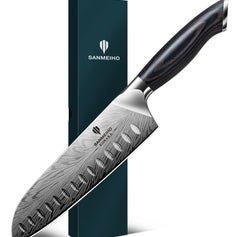
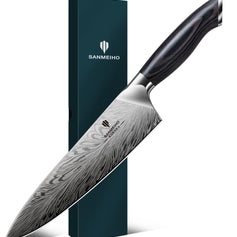
8-inch): The "workhorse" of the kitchen. Whether it is our Damascus series or the volcanic-textured Scoria line, this is your primary tool for slicing, dicing, and mincing.
The Paring Knife: For intricate taA great kitchen is built on versatility. If you are starting your collection, we recommend prioritizing these two:
The Chef’s Knife (sks like peeling, trimming, and small-scale cutting where precision is paramount.
For those who prefer a more specialized approach, our Black Horn series, with its elegant ebony handle and refined 12-degree edge, is an excellent upgrade for tasks requiring delicate control.
-
Are SANMEIHO knives suitable for professional chefs?
Absolutely. Our mission is to bridge the gap between "scale" and "custom." We design our knives to withstand the rigors of a professional kitchen environment while maintaining the aesthetic and ergonomic needs of a chef. Whether you are looking for the striking, natural aesthetic of our Scoria series or the refined, traditional-inspired profile of the Black Horn series, SANMEIHO provides the consistency and performance that professionals demand, optimized for high-volume, high-precision tasks.
-
Why are there so many reviews complaining chipped blade?
Micro chipping can be shown on an even very hard steel knife with poor knife technique and improper use on wrong food. A cook who is unfamiliar with the hardness of Japanese knives may use a knife to cut bones or other very tougher food, or strongly chop down against a cutting board, so as to cause chipping on a blade edge. The damage will be even more pronounced when cutting against ceramic, glass or marble.
Micro chips in the blade edge can also occur if a spot of rust develops on the extremely thin edge because of poor maintenance of the knife. Please make sure the knife is thoroughly dry before storing, the chances of chipping are reduced enormously.
Of course, if there is a problem with the materials or manufacturing itself, we’ll take care of that, too. Please contact us for evaluation.